Large river rocks for landscaping in Goddard, KS do more heavy lifting than small decorative gravel ever could. They anchor dry creek beds, hold back slopes during Kansas downpours, and give a bed a finished look that doesn't wash out or blow away. This guide breaks down real sizes, 2026 pricing per ton, and how much you actually need before you order a truckload.
Large River Rock Sizes Explained
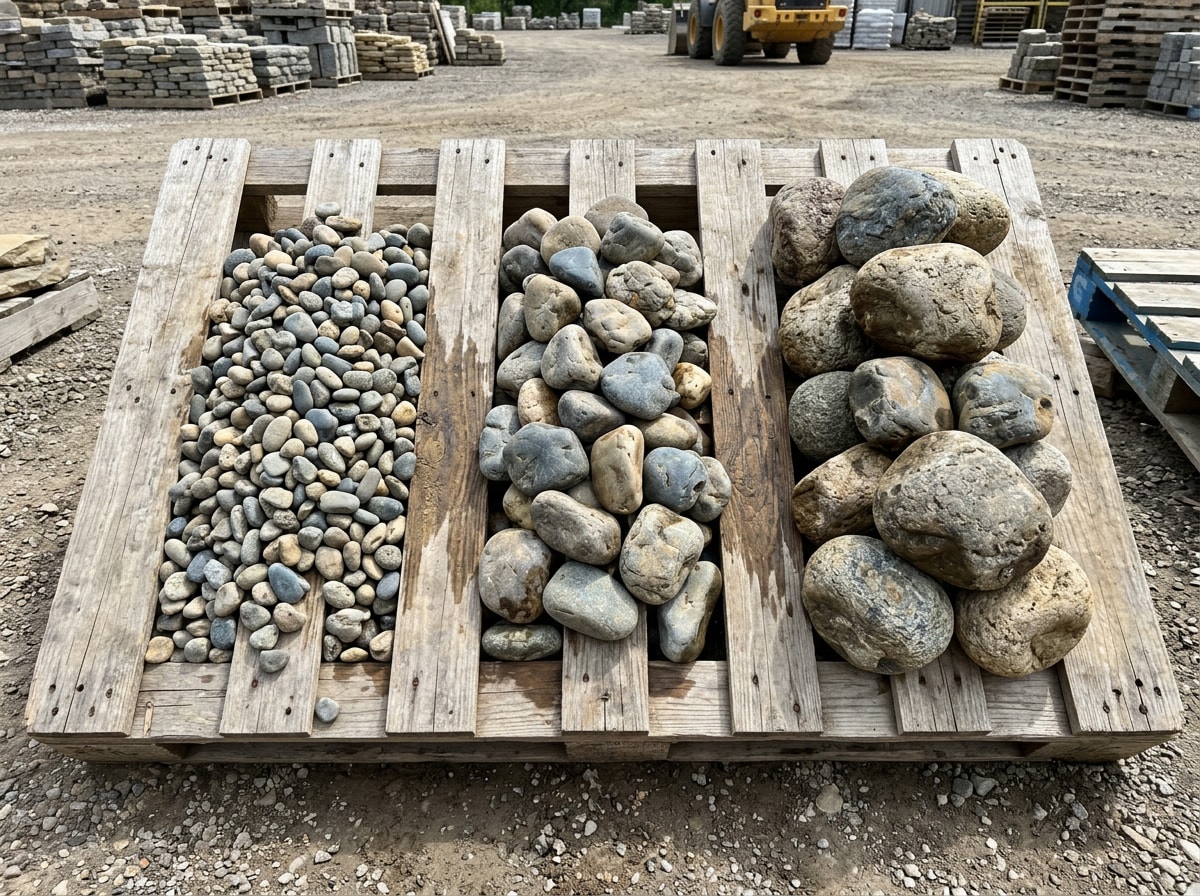
"Large river rock" isn't one product. Suppliers grade it by diameter, and that number changes both the price and the job it's suited for.
| Size Range | Typical Name | Weight Behavior | Best For |
|---|---|---|---|
| 1"-2" | Small/medium river rock | Packs tightly, higher coverage per ton | Ground cover, pathway fill |
| 2"-4" | Medium-large river rock | Moderate air gaps | Dry creek beds, borders, water features |
| 4"-8" | Large river rock / cobble | More air gaps, lower density per yard | Accent boulders, erosion control, retaining edges |
| 8"-24"+ | Landscape boulders | Placed individually, not spread | Focal points, bed anchors, gabion fill |
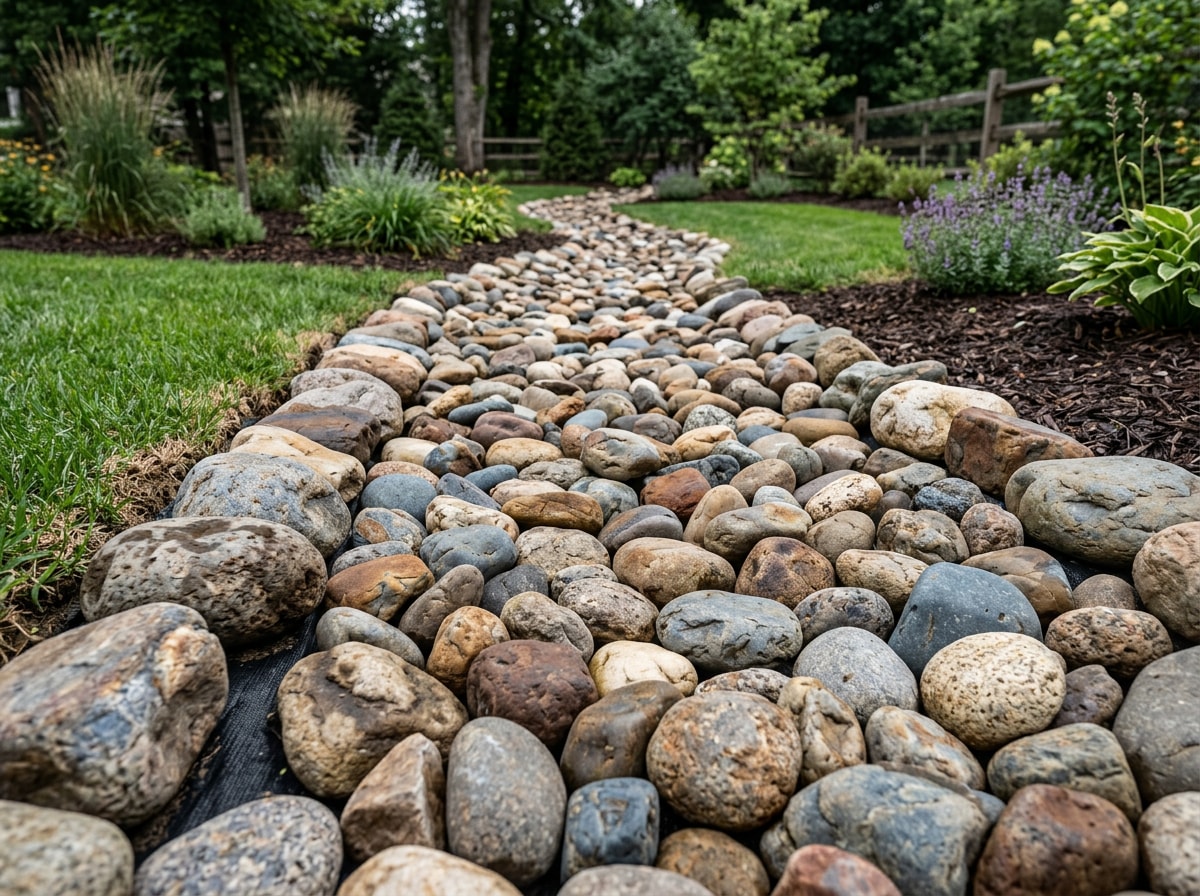
Large stones weigh a little less per yard because of the air gaps between them , which is why a 4"-8" load always covers less ground than the same tonnage of 1" pea gravel. 5-8 inch river rock runs roughly 5 inches to 8 inches and comes in multi-colored tones for decorative uses , and 5-8 inch rocks are a good size for filling gabion cages used in retaining walls, embankments, or rustic accents .
What Large River Rock Costs in the Goddard, KS Area
Pricing scales with size almost in a straight line. medium river rock in the 1 to 3 inch range runs $75 to $200 per ton, while large river rock in the 3 to 5 inch range for borders, water features, and accents runs $100 to $250 per ton , and extra-large river rock from 5 to 12 inches used for retaining walls and focal points runs $100 to $350 per ton .
Jump a size class again and the premium gets steeper. Large river rocks in the 6+ inch range command premium prices of $150 to $400 per ton due to their visual impact and scarcity . Boulders push even higher: landscape boulders cost between $100 and $200 a ton, and these rocks are typically larger than 10 inches, some small enough to carry by hand and others needing a crane or machinery to move .
Coverage drops as size climbs, too. Large river rock in the 4-8 inch range costs $350 to $700 per ton and covers only 30 to 40 square feet per ton at a 2-inch depth , versus roughly double that coverage for 1"-3" stone at the same depth. For mid-size 3"-5" stone, expect better yield: a ton of three to five inch river rock covers roughly 60 to 80 square feet when placed in a single layer .
Most homeowners land somewhere in the middle. The average cost for river rocks is between $60 and $170 per ton, and most homeowners pay between $365 and $1,500 for a river rock landscaping project once delivery and placement are figured in.
How Much Large River Rock Do You Need?
Skip the guesswork math. The key habit is to calculate your area first, pick a depth that fits the use, run the formula, and then land on a ton number rather than starting from a coverage rate and working backward .
- Measure length × width in feet to get square footage.
- Convert your depth to feet (3 inches = 0.25 ft).
- Multiply area by depth, divide by 27 for cubic yards.
- Multiply cubic yards by roughly 1.3-1.4 for tons.
For large 3"-5" stone specifically, the void space between stones is significant enough that a depth formula starts to lose accuracy, so suppliers and experienced installers typically switch to flat coverage rates for this size range . A 150-square-foot dry creek bed in 5"-8" stone, for example, will realistically need 4-5 tons, not the 2 tons a small-gravel calculator would suggest.
Where Large River Rock Works Best in a Goddard Yard
Big stone earns its keep on jobs smaller gravel can't handle:
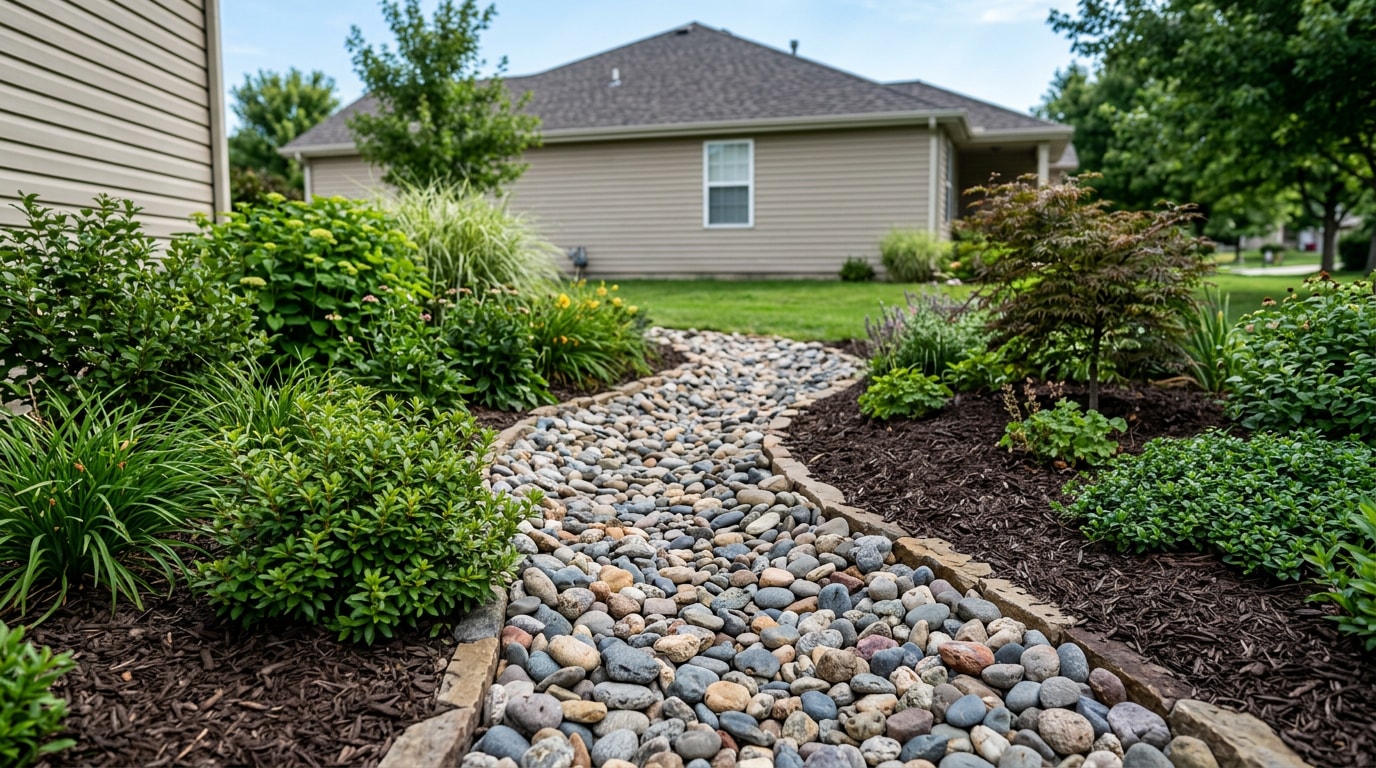
- Dry creek beds and drainage swales — channels heavy clay-soil runoff away from foundations during Kansas thunderstorms.
- Slope and erosion control — weight keeps rock in place where smaller gravel migrates downhill.
- Downspout splash zones — large rock resists the direct force of roof runoff better than pea gravel.
- Accent and focal features — scattered boulders or a cobble border frame a bed without needing yearly refresh.
- Gabion wall fill — 5"-8" stone is a standard fill size for wire-cage retaining walls.
In projects we've handled around Goddard and the rest of Sedgwick County, slopes that drain toward a foundation almost always end up needing 4"-8" stone rather than the 2" starter size most online calculators default to — the smaller rock simply doesn't stay put through a hard spring rain.
Large Rock vs. Mulch in Kansas Clay and Wind
Rock has a durability edge mulch can't match in this region. Mulching is the best choice for nonchemical weed control in the average landscape bed, but material selection is essential — for organic mulches, stick with coarse pine bark or pine needles applied at least 3 inches deep . The catch is wind: in Kansas, wind often whips loose mulch away from planting beds, particularly where landscape fabric is applied underneath, and once that happens the fabric is left flapping with nothing to hold it down unless the "mulch" is rock .
That's the practical case for large river rock on exposed, windy, or slope-adjacent sites: it won't blow into the neighbor's yard, and it won't need replacing every one to two years the way bark mulch does. For a side-by-side comparison of upkeep and long-term cost, our low-maintenance river rock landscaping guide for Andover, KS walks through maintenance schedules in more detail.
Installing Large River Rock the Right Way
- Strip old mulch or sod down to bare soil; large rock laid over decomposing organic material settles unevenly within a season.
- Grade for drainage — slope the bed slightly away from structures before adding fabric.
- Install commercial-grade landscape fabric, overlapping seams by at least 6 inches.
- Place boulders and large accent stone first, then fill around them with the coverage rock.
- Rinse the finished bed with a hose to pull dust off the stone and bring out true color.
Large stone resists the drainage problems that come with hardscaping a yard entirely in impervious material. Rain gardens and permeable landscape features allow water to soak into the ground while watering plants rather than sheeting off-site, which is worth keeping in mind if your dry creek bed ties into a broader drainage plan — see the EPA's guidance on rain gardens and permeable landscaping for the underlying principles.
DIY vs. Hiring a Pro in Goddard, KS
Bagged large river rock from a big-box store works for small accent beds. Bulk tonnage delivery makes more sense once you're past a few hundred square feet, mainly because moving 4"-8" stone by hand is slow, physical work, and poor grading undoes the drainage benefit the rock is supposed to provide.
If you're weighing a full bed renovation, our hardscape installation and landscape construction teams handle grading, fabric, and stone placement as one job, and our landscape design service can plan a dry creek bed or boulder feature around your home's actual drainage path rather than guessing. See examples of finished work on our projects page, or check service coverage for your street on the Goddard, KS area page.
For soil and plant-bed context specific to this part of Kansas, K-State Research and Extension's Sedgwick County xeriscape publication and the K-State Turf and Landscape newsletter both cover how local wind and mulch longevity should factor into a rock-vs-mulch decision.
Ready to move forward? Get a free estimate and we'll walk your property, measure the bed, and quote tonnage before anything gets delivered. You can also browse our full range of outdoor services from the Stellar Wichita homepage.
FAQ
Which river rock is best for landscaping?
It depends on the job. Use 1"-3" stone for general ground cover and pathway fill, 3"-5" for dry creek beds and borders, and 5"-8"+ for erosion control, gabion fill, and focal accents. Large and extra-large river rock from 3 to 12 inches costs considerably more per ton but covers less area, and these stones are best used as accents, borders, or focal points rather than broad ground cover .
What are big rocks for landscaping called?
Large landscape stone goes by several names, boulders, rip rap, accent stone, cobble, or simply large river rock, depending on size, shape, and whether it was quarried or naturally tumbled.
How much does large river rock cost per ton?
Expect roughly $100-$250 per ton for 3"-5" stone and $150-$400+ per ton for 6" and larger stone, before delivery. Large landscaping rocks cost $100 to $350 per ton on average nationally, with exact pricing depending on source, color, and distance from the quarry.
How long does large river rock last?
Decades, with minimal upkeep. it doesn't need yearly replacement the way organic mulch does, since the stone itself doesn't decompose, fade, or wash away under normal conditions.
How do you clean large river rock?
Rinse it with a hose to knock off dust, pull any weeds or trapped debris by hand, and occasionally power-wash heavily soiled sections to restore the stone's original color.
How much large river rock do I need for a 100 sq ft bed?
At a 3-inch depth with 4"-8" stone, plan on roughly 3-4 tons, since large rock covers less area per ton than small gravel. For 3"-5" stone at the same depth, 1.5-2 tons is usually closer to accurate. Always round up and order a 10% buffer for settling.