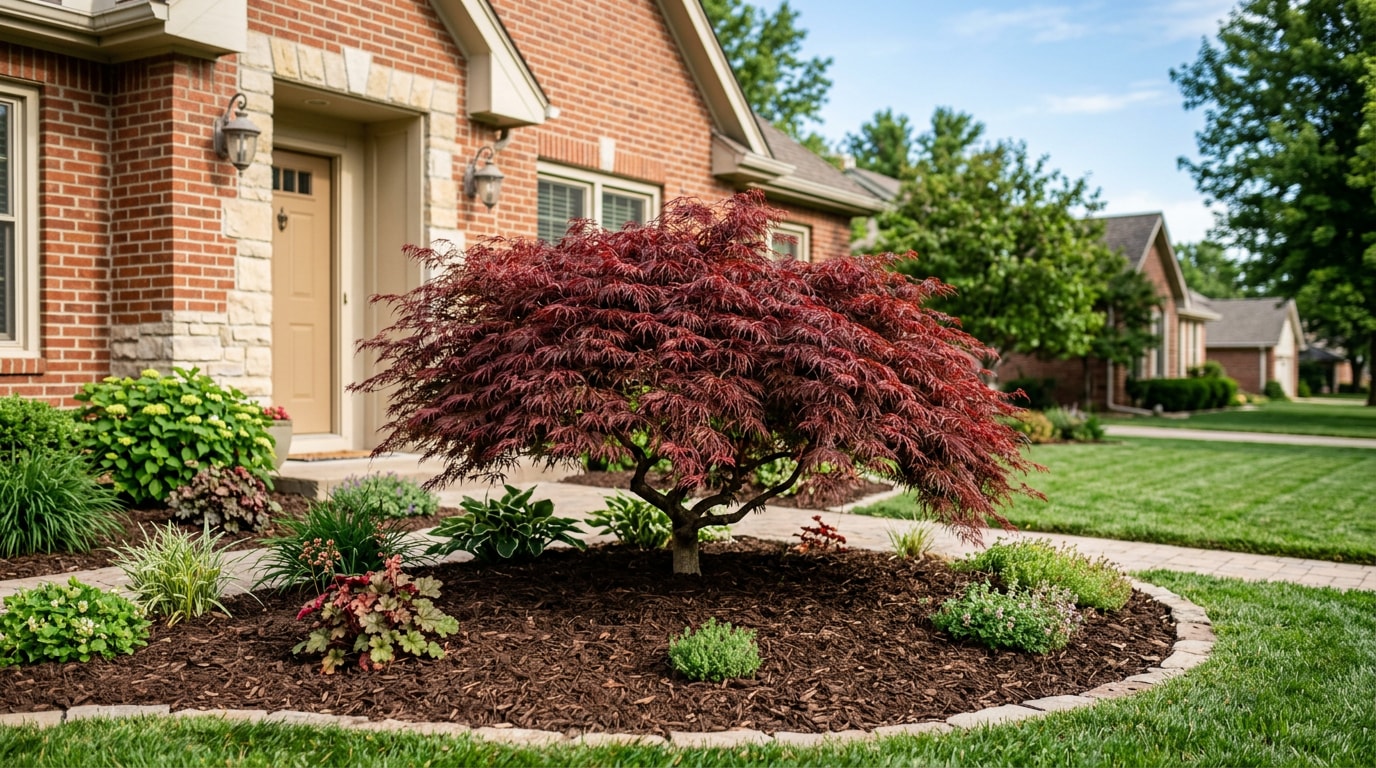
Landscaping with a dwarf Japanese maple in Wichita, KS means choosing a compact cultivar that can take brutal summer sun and clay soil without losing its color. These small trees pack the same layered foliage and sculptural branching as full-size Japanese maples into a 4- to 8-foot frame that fits foundation beds, patios, and tight city lots. Here's how to pick the right variety, place it correctly, and keep it healthy through a Kansas summer.
What Is a Dwarf Japanese Maple?
A dwarf Japanese maple is a slow-growing, compact cultivar of Acer palmatum that typically gains just a few inches to a foot of height per year, topping out at 4 to 8 feet instead of the 15 to 25 feet common to standard Japanese maples. That smaller scale makes dwarf varieties a practical small landscape tree for compact Wichita lots.
Standard Japanese maples can eventually shade out a small yard or outgrow a foundation bed. Dwarf and semi-dwarf cultivars stay proportional to modest spaces for decades instead. Many Wichita properties, especially newer subdivisions with tighter lot lines, simply don't have room for a towering shade tree near the house. A compact Japanese maple solves that problem while still delivering dramatic color.
Want to see how these trees look installed, not just listed in a catalog? Browse our project gallery for completed Wichita-area landscape beds, or get a free estimate to talk through placement for your yard.
Growing Conditions: What Wichita's Zone Actually Means
Here's something worth correcting before you shop: a lot of older gardening guides still list Wichita as USDA Hardiness Zone 6b. That changed with the 2023 USDA Plant Hardiness Zone Map update, which moved Wichita fully into Zone 7a (winter lows of 0°F to 5°F). Kansas State University Research and Extension noted that the statewide update pushed the warm end of the range further south, and "In Kansas, most of the state shifted about a half zone warmer. We still have pockets of Zone 5 in the north, but the range of Zone 7 in the southern part of Kansas is significantly larger." You can confirm your exact ZIP code on the official USDA Plant Hardiness Zone Map.
Most dwarf Japanese maple cultivars are rated hardy to Zone 5 or 6, so Wichita's winter cold isn't the real obstacle once a tree is established. Summer is the bigger challenge. Afternoon temperatures regularly top 95°F, and dry wind pulls moisture out of thin maple leaves faster than roots can replace it. That combination causes leaf scorch, which shows up as brown, crispy leaf edges by late July even on otherwise healthy trees.
Kansas State University's own extension guidance on ornamental trees backs this up directly, noting that Japanese maple does best when a grower will "Plant to east-northeast of structure for protection. Best in southern and eastern Kansas." In our crews' experience installing dwarf maples across Sedgwick County yards, a spot with morning sun and afternoon shade from a fence, pergola, or taller shrub consistently outperforms a sprinkler-heavy watering schedule at preventing scorch. Consistent, deep watering during July and August, rather than frequent shallow watering, also helps trees handle Kansas heat with less stress. If you need an ongoing watering and care plan built around your yard's microclimate, our landscape maintenance team can set one up.
The bigger filter for choosing a cultivar in this zone isn't cold hardiness, it's heat and sun tolerance. A cold-tolerant dwarf maple that also handles reflected heat from pavement or a south-facing wall will perform more reliably here than one picked on hardiness rating alone.
Best Dwarf Japanese Maple Varieties for Wichita Landscapes
Picking the right variety comes down to color, growth habit, and how much sun a planting spot actually gets. The table below compares mature size, foliage color, sun tolerance, and Wichita zone fit, so you can narrow the list before shopping.
| Variety | Mature Size | Foliage Color | Sun Tolerance | Wichita Zone Fit |
|---|---|---|---|---|
| Bloodgood (standard, not dwarf) | 15–20 ft | Deep red-purple | Full sun to part shade | 7a, heat tolerant |
| Karasugawa | 6–8 ft | Pink, cream, green variegation | Part shade | 7a, protect from wind |
| Germaine's Gyration | 6–8 ft | Green with red tips | Full sun to part shade | 7a |
| Inaba Shidare | 6–10 ft | Deep red, weeping | Part shade to full sun | 7a |
| Jeddeloh Orange | 3–5 ft | Orange-red new growth | Part shade | 7a, sheltered spot |
Red, Purple, and Burgundy Dwarf Maples
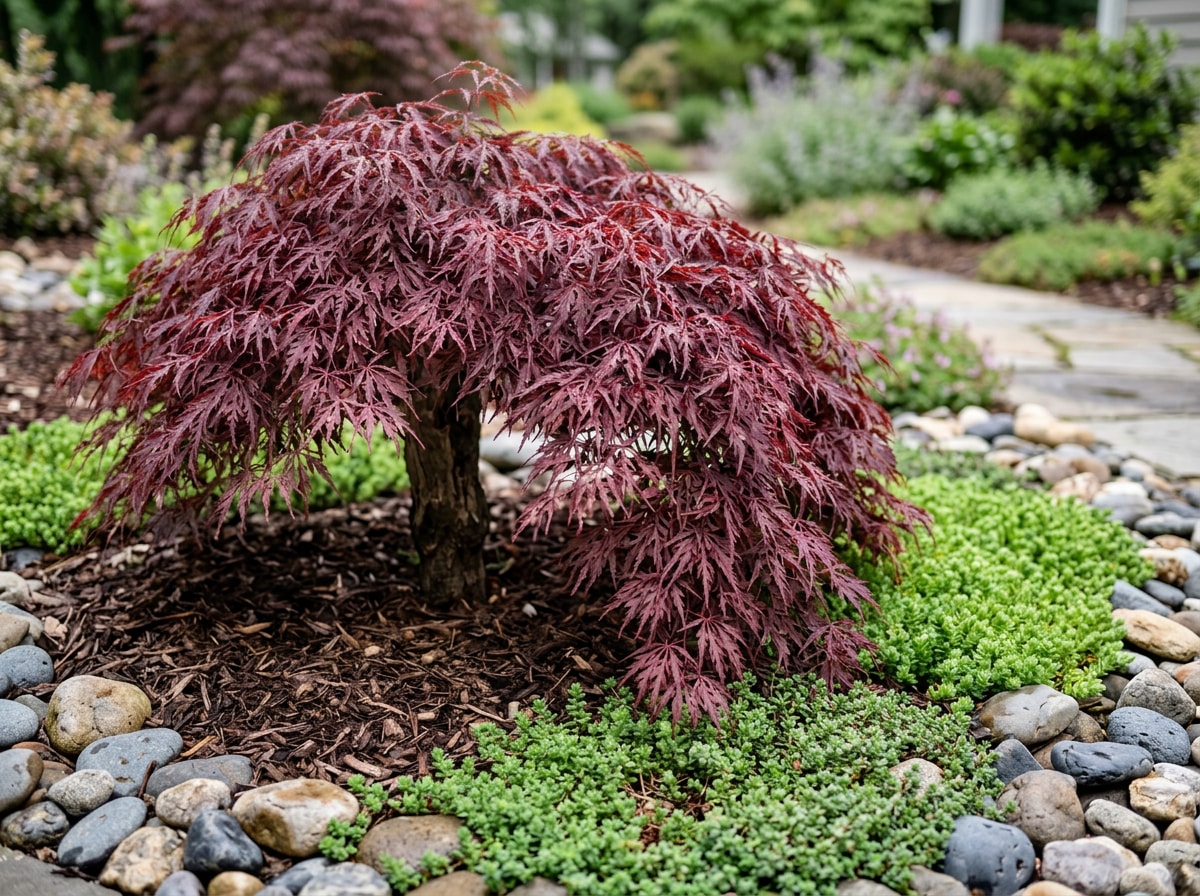
Red, purple, and burgundy-toned dwarf maples are the most popular color group, prized for foliage that holds its color from spring through fall instead of fading to green in summer heat. Garnet is a widely grown example: deeply cut, burgundy foliage on a weeping, mounded form that rarely exceeds 6 to 8 feet tall. These cultivars tend to hold their best burgundy color with a few hours of afternoon shade, which suits Wichita's intense summer sun well.
Multicolored Dwarf Maples
Variegated cultivars bring pink, cream, and green together on the same leaf, reading almost like a flowering shrub from a distance. That variegation is delicate, though. Too much direct afternoon sun can scorch the lighter patches or cause leaves to revert to solid green. Planting these where they get morning sun and afternoon shade protects the coloring through a Kansas summer.
Bloodgood Japanese Maple
Bloodgood is one of the most widely available Japanese maples at Wichita nurseries, and it's worth understanding before adding it to a small-space wish list. Kansas State University extension lists it as "One of the best for red/purple foliage color retention. Readily available." But it is not a true dwarf. Mature specimens typically reach 15 to 20 feet tall and nearly as wide, so for a compact bed, Bloodgood usually needs more room than it first appears to need.
Karasugawa
Karasugawa stands out for dramatic pink, cream, and green variegated foliage on a compact, upright habit that typically stays under 8 feet tall. New spring growth emerges almost entirely pink before settling into a mixed pattern through summer. It makes a striking focal point near an entry or patio, though it benefits from afternoon shade to protect the variegation from scorching.
Germaine's Gyration
Germaine's Gyration gets its name from the twisting, contorted branch structure that gives it visual interest even in winter after the leaves drop. It typically reaches 6 to 8 feet at maturity, with green foliage tipped in red through the growing season. It works well as a sculptural specimen where the branching can be appreciated up close, such as near a walkway.
Inaba Shidare
Inaba Shidare is a weeping Japanese maple with finely cut, deep red foliage that cascades from arching branches. Mature plants typically reach 6 to 10 feet tall and wide, forming a graceful mounded shape without pruning or training. Its weeping form makes it a strong choice for softening the corner of a patio or framing a smaller bed as a standalone specimen.
Jeddeloh Orange
Jeddeloh Orange is a low, cascading dwarf maple that rarely tops 3 to 5 feet, making it one of the smallest cultivars covered here. New growth emerges in shades of orange-red before shifting to green through summer. Its mounded, spreading habit suits container plantings or the front edge of a layered bed where a taller maple would overwhelm the space.
Designing with Dwarf Maples
Dwarf Japanese maples work well in two basic settings: planted directly into a landscape bed, or grown in a container on a patio or porch. In-ground plantings suit permanent focal points, like next to an entry walk, at the corner of a foundation bed, or anchoring a mixed border. A container Japanese maple gives homeowners the flexibility to move a tree out of harsh afternoon sun or into a sheltered spot before a hard freeze.
For small garden design, a single dwarf maple often does more visual work than a cluster of shrubs:
- Its layered branching and seasonal color shift (spring red, summer green or burgundy, fall gold or crimson) gives a bed structure without competing for space.
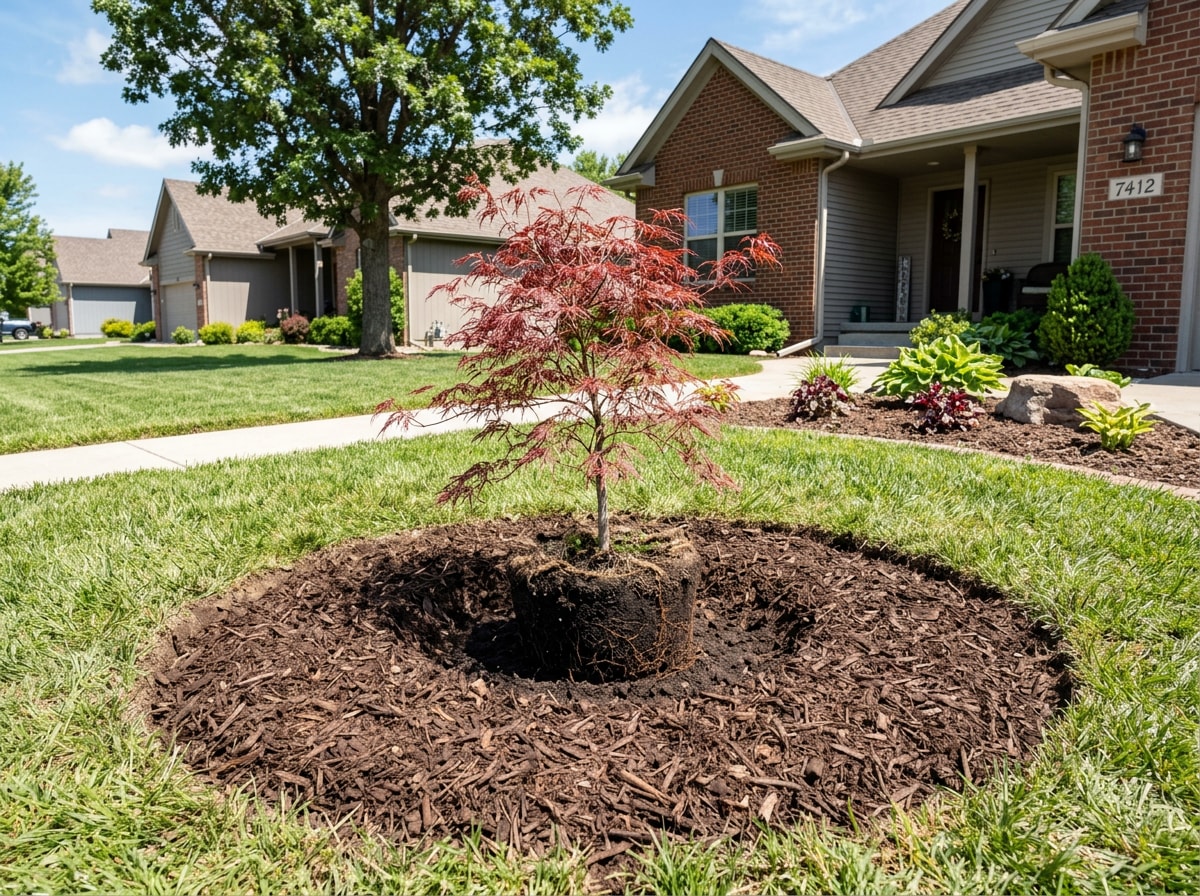
- Pairing a dwarf maple with a mulch ring, a few boulders, or low groundcover echoes a Japanese-garden feel without a full redesign.
- Used this way, one tree becomes the accent that pulls an entire planting bed together.
For design ideas that go beyond a single accent tree, see our deeper breakdown of Japanese landscaping design in Bel Aire, KS. If you'd rather have a professional plan the bed around it, our landscape design team can map out sun exposure, drainage, and companion plants before anything goes in the ground.
Choosing Trees by Goal
Instead of browsing by variety alone, it helps to start with the goal for the space.
- Small space landscaping: A dwarf or semi-dwarf cultivar under 8 feet keeps proportions balanced near a foundation, walkway, or patio.
- A true accent tree: A strongly colored cultivar like Garnet or Inaba Shidare draws the eye without crowding neighboring plants, more than a green-leafed option would.
- Afternoon shade matters most: Most Japanese maples, dwarf or not, perform best out of unbroken afternoon sun in Wichita. Full summer sun through July and August can scorch even heat-tolerant cultivars.
Not sure which spot in your yard gets the right mix of light? Get a free estimate and Stellar Wichita's design team will walk the property with you before you buy.
Buying and Planting Trees in Wichita
Buying trees that will actually survive here starts with sourcing nursery-grown stock from a supplier familiar with local soil and climate, rather than a big-box tree grown for a different region. Local and regional nurseries are also more likely to offer delivery for landscape-size specimens that aren't practical to transport in a standard vehicle.
Stellar Wichita installs and maintains landscape beds throughout Wichita and nearby communities including Andover, Goddard, and Bel Aire. Professional landscape construction crews handle the heavy lifting of unloading a freight-delivered tree and setting the root ball at the correct depth, which matters more for long-term survival than most buyers expect.
How to Read Your Hardiness Zone
A hardiness zone rating tells you the average annual minimum winter temperature for a region, not a guarantee of how a specific tree will perform in your yard. Before buying, check a plant tag or product listing for its rated zone range; most dwarf Japanese maples list Zone 5 or 6 through 8 or 9. If Wichita's 7a classification falls inside that range, the tree should survive typical winters here, though microclimates near walls or pavement can push actual conditions a zone warmer or colder than the map suggests.
What Freight Delivery Actually Means
Landscape-size trees, including larger dwarf maple specimens, are usually too big to ship in a standard box. They arrive via freight delivery on a pallet or in a specialized tree box instead, already several feet tall with an established root ball rather than as a small starter plant. Expect a scheduled delivery window, and plan to get the tree into the ground or a container within a day or two of arrival.
The Guarantee, in Plain Terms
A plant establishment or "thrive" guarantee typically covers a tree that fails to leaf out or dies within a set window after delivery, provided it was planted and watered according to the included instructions. It usually does not cover damage from improper planting depth, lack of watering, or extreme weather outside normal range. Reading the specific terms before buying avoids surprises if a tree struggles after the first season.
Small Doesn't Have to Mean Low-Impact
A dwarf cultivar's modest mature size doesn't translate to a modest presence in the yard. The same layered branching, seasonal color shift, and sculptural winter silhouette that make full-sized Japanese maples landscape favorites are all present in the compact forms covered throughout this guide, just scaled to fit a smaller footprint.
Whether it's a single Garnet anchoring a mulch bed or a Jeddeloh Orange softening a patio corner, these trees prove that small tree, big impact isn't just a marketing line for Wichita yards with limited space. Visit Stellar Wichita to see the full range of landscaping services available for your property, or contact us directly for a free estimate on your next planting project.
This guide was put together by Stellar Wichita's landscape design team, who plant, prune, and troubleshoot dwarf Japanese maples in yards across Sedgwick County every growing season. Have a specific yard or spot in mind? Reach out through our contact page and we'll help you pick a variety that fits it.
Frequently Asked Questions
What are the best dwarf Japanese maple trees for Wichita?
Garnet stands out for reliable burgundy foliage and a weeping form, Inaba Shidare offers a similar weeping habit with deeper red color, and Jeddeloh Orange suits the smallest spaces at just 3 to 5 feet tall. Karasugawa is worth considering for variegated color in a protected spot. All four handle Wichita's winter cold comfortably; the main variable is matching each one to the right amount of afternoon shade.
Do Japanese maples grow well in Kansas?
Yes, with the right placement. Japanese maples are rated for Kansas's current hardiness zones, and Kansas State University extension specifically recommends them for southern and eastern Kansas when planted on the east or northeast side of a structure for wind and heat protection. The main risk isn't winter cold, it's scorched leaves from unbroken summer sun and wind.
How many years does it take for a Japanese maple to grow to full size?
Dwarf cultivars grow slowly, typically adding just a few inches to about a foot of height per year. Most reach a mature size of 6 to 8 feet in 10 to 15 years under good growing conditions, though exact timing varies with soil, water, and sun exposure. Standard, non-dwarf cultivars like Bloodgood grow faster but end up far larger overall.
How much sun do dwarf Japanese maples need?
Most dwarf Japanese maples do best with morning sun and afternoon shade in Wichita's climate. A few hours of direct morning light keeps foliage color vivid, while shade during the hottest afternoon hours prevents leaf scorch. Variegated cultivars need more shade protection than solid red or green varieties.
Can Japanese maple tree roots damage a foundation?
Japanese maple roots are generally shallow and non-aggressive compared to large shade trees, and dwarf cultivars pose even less risk given their smaller overall size. Research published by the International Society of Arboriculture found that "the average distance at which foundation damage was recorded varied from 2.5 m for cypress (Cypressus) to 11 m for poplar (Populus) with damage from most species occurring between 5 m and 7 m" , and those figures come from large, high-water-demand species, not compact ornamentals. A practical rule of thumb is to plant a dwarf Japanese maple at least as far from a foundation as its mature spread, generally 6 to 10 feet, to keep roots clear of footings.
Is Miracle-Gro good for Japanese maples?
General-purpose fertilizers like Miracle-Gro can work for Japanese maples in small doses, but they're formulated for fast growth rather than the slow, controlled growth that keeps dwarf cultivars healthy and well-shaped. A fertilizer labeled for acid-loving or ornamental trees, applied lightly in early spring, is usually a better fit. Over-fertilizing can push leggy growth and make foliage more prone to burning in Wichita's summer heat.